Why Now
Artificial intelligence is moving beyond analysis and content generation into systems that can take actions. The National Institute of Standards and Technology (NIST) defines artificial intelligence agents as systems capable of planning and taking autonomous actions that affect real-world systems or environments. In May 2026, NIST reported that respondents to its inquiry on artificial intelligence agent security broadly agreed that agents present novel security threats and that established cybersecurity practices must be adapted to address them.[1][2]
For executives, the issue is not theoretical. When an artificial intelligence agent is connected to enterprise applications, it can potentially retrieve documents, invoke tools, generate external communications, alter records or support operational decisions. If proprietary information, customer data, source code, financial records or strategic plans are within reach, weak governance can become a direct business exposure.
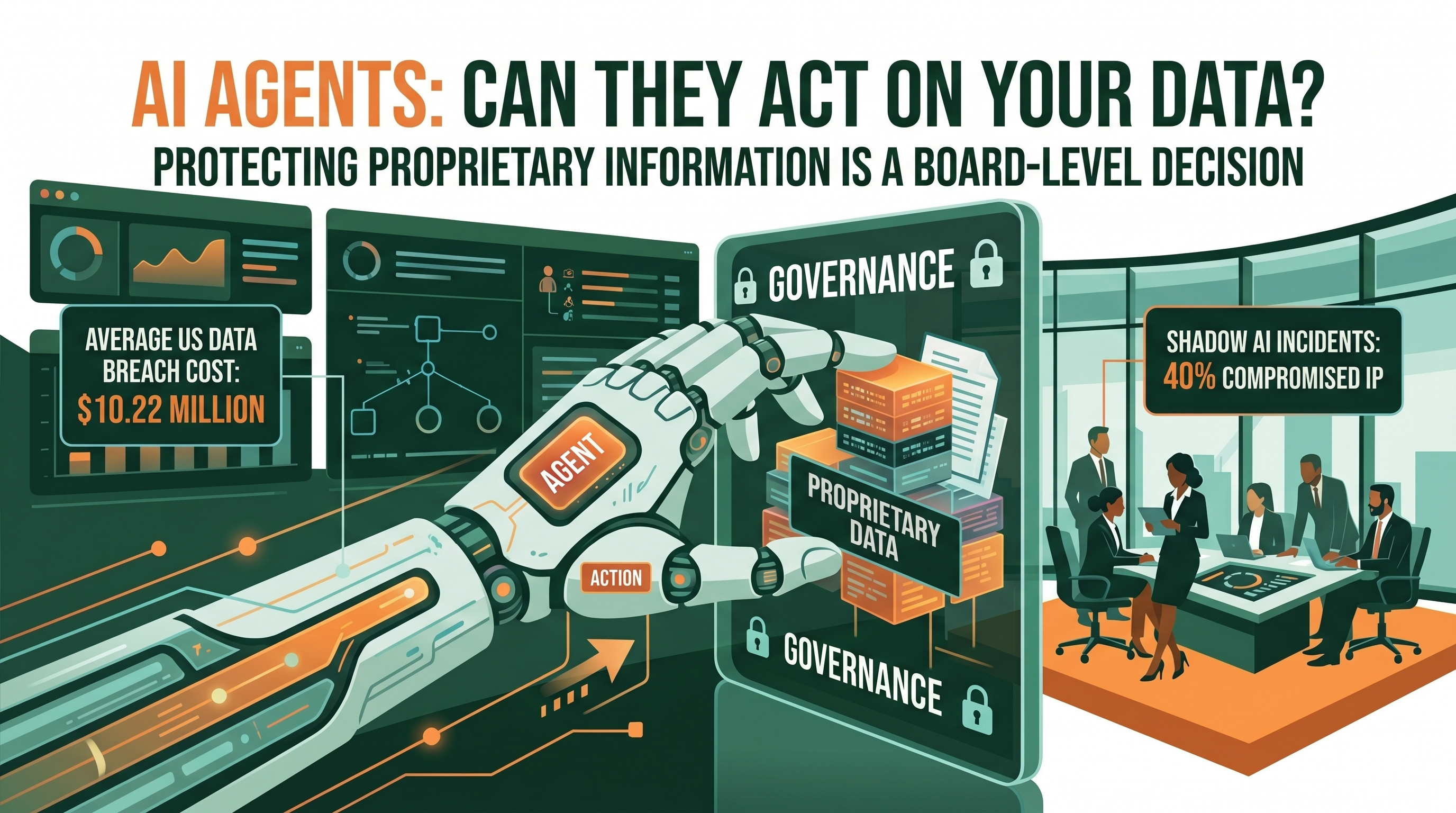
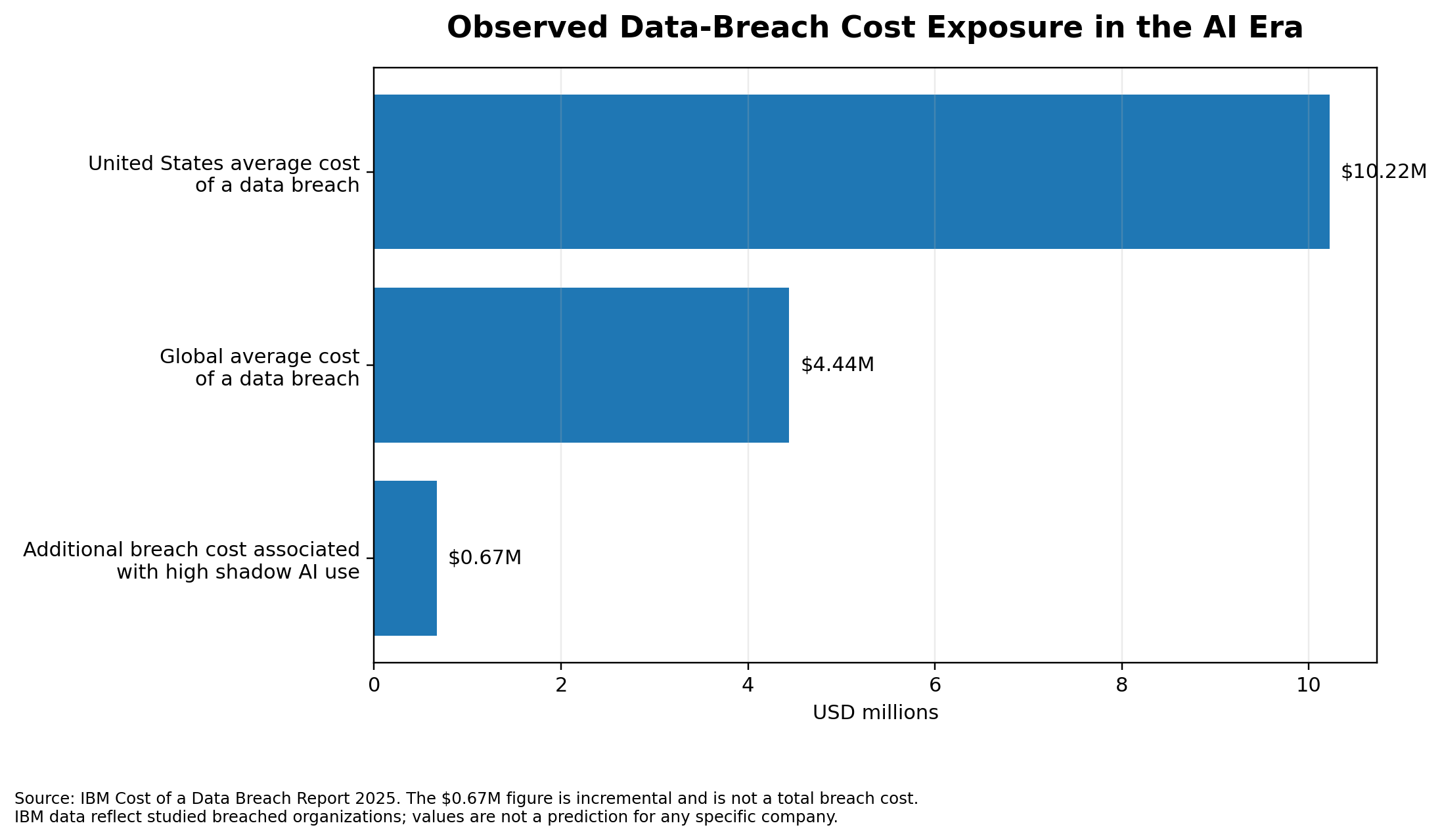
IBM's 2025 Cost of a Data Breach Report provides measurable evidence. In the United States, the average cost of a data breach reached $10.22 million. Organizations with high levels of shadow artificial intelligence observed average breach costs $670,000 higher than organizations with little or no shadow artificial intelligence. Security incidents involving shadow artificial intelligence compromised intellectual property in 40% of cases studied, compared with 33% across breaches globally.[3]
Executive Summary
Artificial intelligence governance is now an enterprise-value control. Boards and executive teams should require clear answers to five questions:
- Which artificial intelligence systems and agents are operating in the organization?
- What proprietary or regulated data can each system access?
- What actions can each agent take without human approval?
- How are unsafe access, leakage or misuse detected and contained?
- What evidence demonstrates both business value and effective control?
The objective is not to prevent responsible artificial intelligence adoption. It is to ensure that autonomy is earned through controlled access, bounded authority, testing, monitoring and executive accountability.
Verified Evidence for Decision-Makers
| Verified Finding | Reported Result | Executive Significance |
|---|---|---|
| IBM: average United States cost of a data breach | $10.22 million | A major incident can materially affect earnings and capital allocation. |
| IBM: higher average breach cost associated with high shadow artificial intelligence use | $670,000 | Unapproved artificial intelligence usage creates measurable financial exposure. |
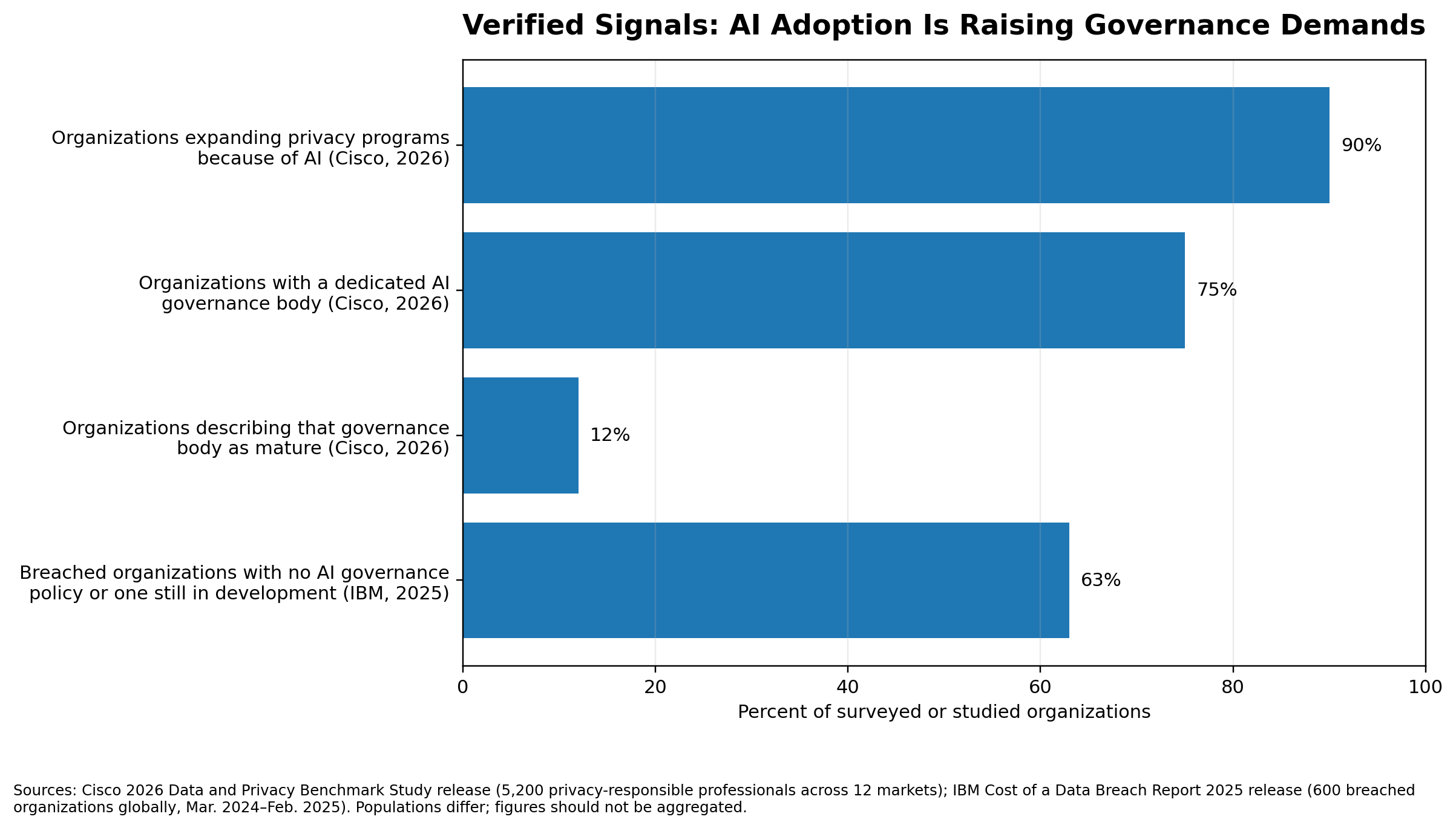
| IBM: breached organizations with no artificial intelligence governance policy or one still being developed | 63% | Governance deficiencies are present among organizations already experiencing breaches. |
| IBM: shadow artificial intelligence incidents involving compromised intellectual property | 40% | Proprietary information requires explicit protection across artificial intelligence workflows. |
| Cisco: organizations expanding privacy programs because of artificial intelligence | 90% | Data governance is becoming foundational to artificial intelligence adoption. |
| Cisco: organizations describing their artificial intelligence governance committees as mature and proactive | 12% | Governance maturity is not keeping pace with deployment pressure. |
| Cisco: organizations viewing privacy as essential to customer trust in artificial-intelligence-powered services | 95% | Responsible data use is directly connected to market confidence. |
Cisco's findings are based on a survey of more than 5,200 information technology, technology and security professionals with data-privacy responsibilities across 12 markets. IBM's findings are based on organizations that experienced data breaches. These datasets should be interpreted separately, not combined into a single benchmark.[3][4]
The Executive Risk: Proprietary Information Moving Without Sufficient Control
Artificial intelligence agents become materially different from stand-alone analytical tools when they are connected to enterprise data and operational systems. An agent that can retrieve confidential files, invoke external tools or initiate actions may create a faster path for disclosure or misuse if access is poorly governed.
The assets at risk extend beyond personal information. They may include:
- Product designs, research data and source code.
- Pricing strategies, forecasts and acquisition materials.
- Customer analytics, underwriting models and internal decision logic.
- Contracts, regulatory documents and confidential communications.
A policy instructing employees not to paste confidential information into artificial intelligence tools is insufficient where agents can retrieve or transmit information through integrated systems. Protection must be enforced through architecture, permissions and monitoring.
Six Actions Executives Should Require Now
1. Establish One Authoritative Artificial Intelligence Inventory
Record approved and discovered artificial intelligence systems, agents, models, vendors, business owners, connected tools, accessible data and risk classifications. Unknown systems cannot be governed effectively.
2. Define and Enforce Proprietary-Data Boundaries
Classify sensitive information and establish rules determining which artificial intelligence workflows may access, process or transmit it. Apply access controls, data-loss prevention, redaction or tokenization where appropriate.
3. Treat Agents as Privileged Non-Human Identities
Each production agent should have an accountable owner, scoped credentials, limited permissions and an approved set of tools. Agents should not inherit broad employee access or rely on uncontrolled shared accounts.
4. Require Authorization for Consequential Actions
Payments, external disclosure of confidential material, production-code changes, customer-record modifications and other irreversible activities should be subject to policy controls and, where warranted, human approval.
5. Test and Monitor Agent Behavior
NIST identifies indirect prompt injection, data poisoning and harmful agent actions as relevant risks. Organizations should test agents before deployment and monitor their data access, tool use, denied requests, escalations and anomalous behavior during operation.[1]
6. Report Value and Risk Together
Artificial intelligence dashboards should show realized business benefits alongside sensitive-data access, blocked events, testing results, incidents and remediation status. Scale should follow demonstrated value and demonstrated control.
The Control Architecture
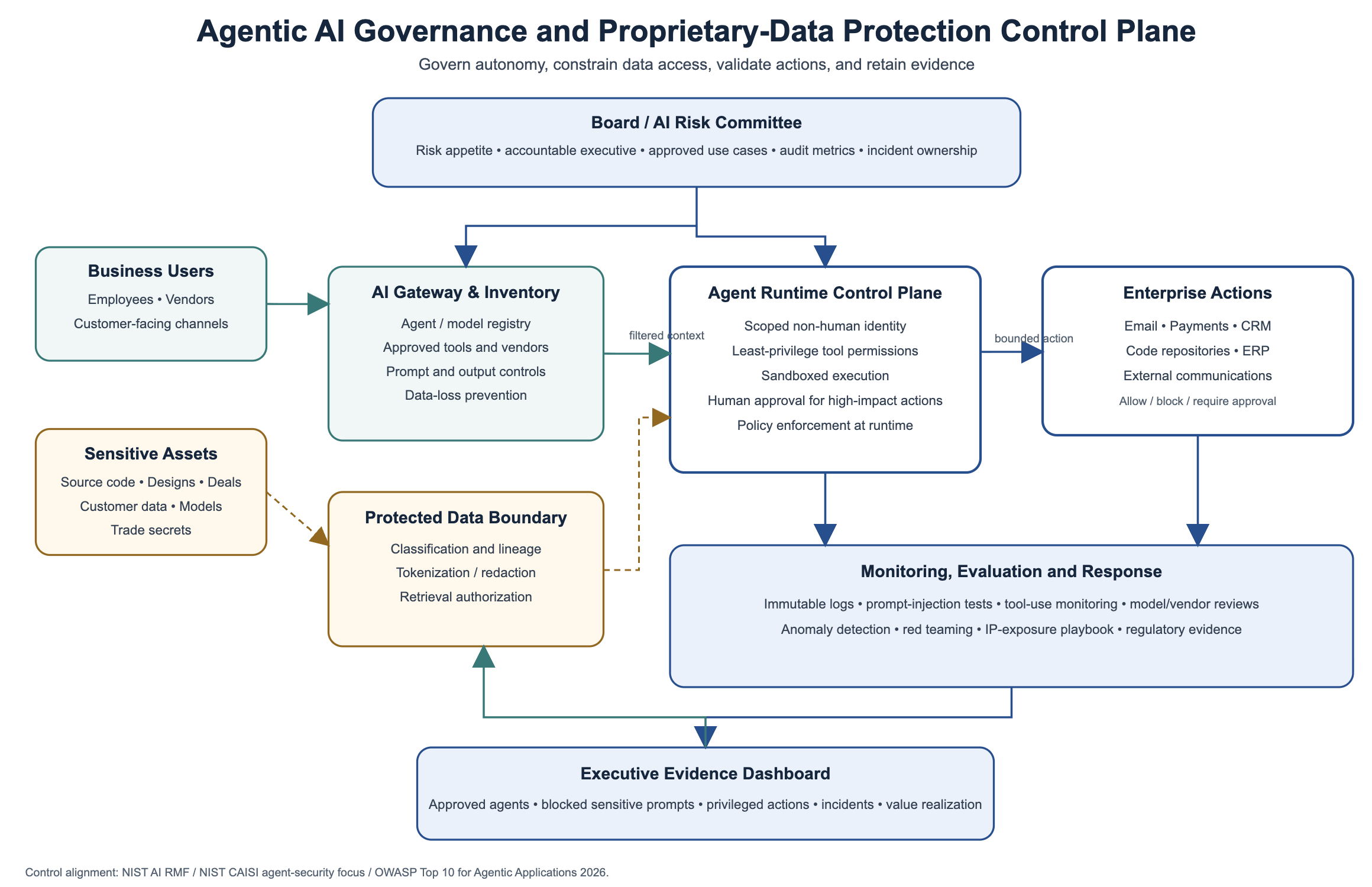
A defensible operating model places governance above deployment and controls around every material agent workflow:
- Board and executive oversight → risk appetite, accountability and performance metrics
- Artificial intelligence gateway and inventory → approved models, agents, tools and vendors
- Protected-data boundary → classification, access rules and loss-prevention controls
- Agent runtime controls → bounded identity, least privilege and action authorization
- Monitoring and response → logs, testing, anomaly detection and incident handling
This approach is consistent with NIST's Artificial Intelligence Risk Management Framework, which is designed to incorporate trustworthiness considerations into the design, development, use and evaluation of artificial intelligence systems.[5]
The Leadership Decision
Artificial intelligence agents can create value only when executives can trust the data they access and the actions they take. The board-level standard should be clear: no agent should reach proprietary information or execute material actions unless its authority is bounded, its behavior is monitored and its business value is measurable.
Organizations that govern autonomy well will be positioned to scale artificial intelligence with confidence. Those that do not may discover that their most powerful new capability has become an uncontrolled channel to their most valuable information.
Sources
- National Institute of Standards and Technology, CAISI Issues Request for Information About Securing AI Agent Systems, January 12, 2026.
- National Institute of Standards and Technology, Summary Analysis of Responses to the Request for Information Regarding Security Considerations for AI Agents, May 18, 2026.
- IBM, Cost of a Data Breach Report 2025, official report and release, July 30, 2025.
- Cisco, 2026 Data and Privacy Benchmark Study, January 2026.
- National Institute of Standards and Technology, Artificial Intelligence Risk Management Framework: Generative Artificial Intelligence Profile, July 26, 2024.
Smart Tech LLC: Governance that enables scale. Controls that protect value. Evidence that supports decisions.