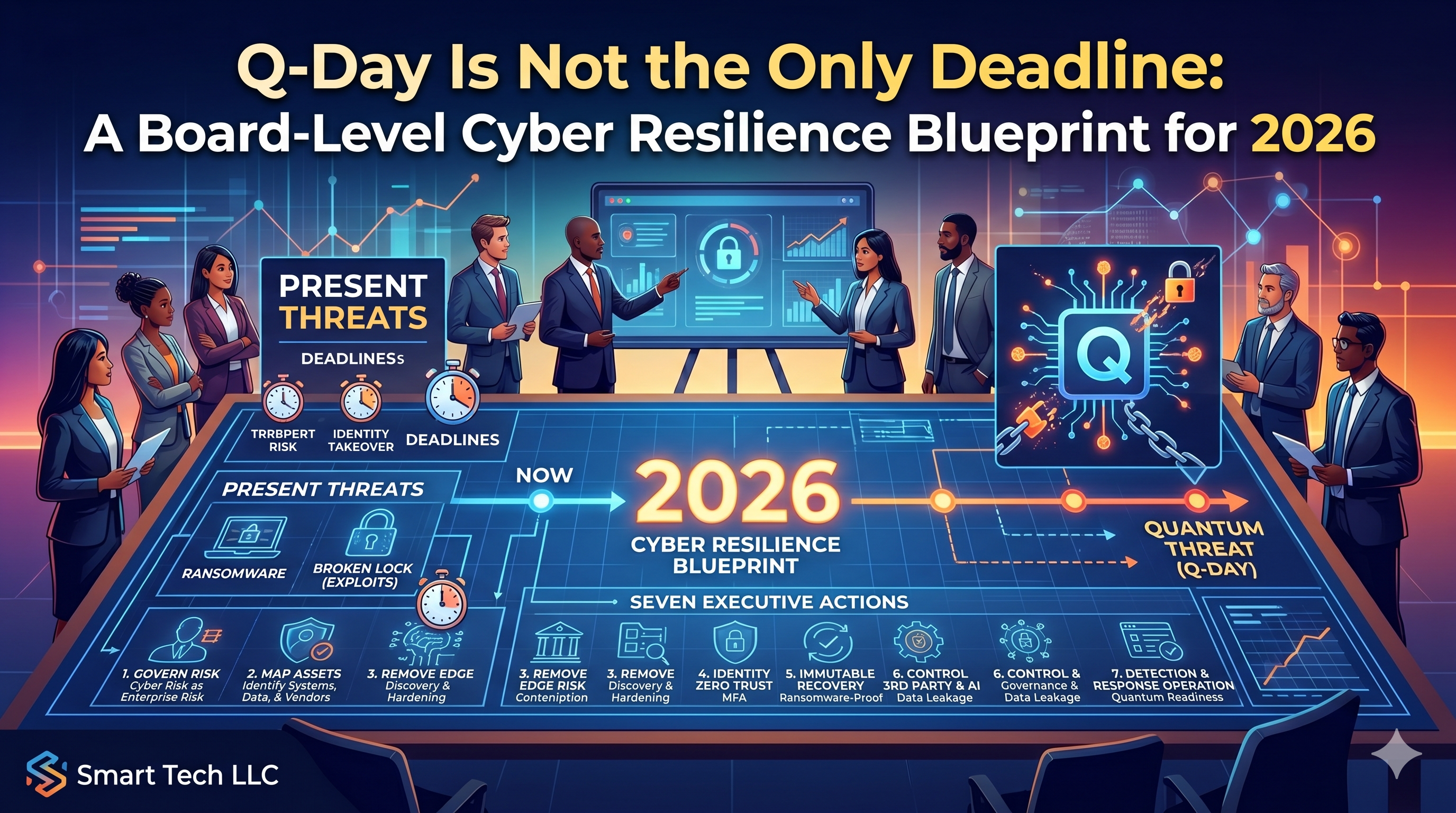
Executive Summary
Cybersecurity is now a balance-sheet and trust issue, not an information technology checklist. Executives must address two horizons simultaneously: attacks already disrupting organizations, including exploited vulnerabilities, identity takeover, ransomware designed to destroy recovery, third-party exposure, and ungoverned artificial intelligence; and the longer-life confidentiality risk that encrypted data stolen today may be decrypted once cryptographically relevant quantum computing becomes available.
For a regional bank, the objective is clear: preserve availability of banking services, confidentiality of customer and proprietary data, regulatory defensibility, and customer confidence.
Why Now
Verizon's 2026 Data Breach Investigations Report states that software vulnerabilities initiate 31% of breaches and ransomware is involved in 48%.[1] Mandiant's 2026 frontline incident findings report exploits as the leading initial infection vector at 32%, with criminal access hand-offs collapsing to 22 seconds and ransomware operators targeting backups, identity services, and virtualization platforms.[2] CrowdStrike reports an average electronic-crime breakout time of 29 minutes in 2025.[3]
Meanwhile, the National Institute of Standards and Technology finalized its first three post-quantum cryptography standards in August 2024; its migration program calls for cryptographic discovery and prioritized migration roadmaps now.[4][5] No authoritative source establishes a date for "Q-Day"; planning is justified by migration lead time and the risk of data being collected today for future decryption.
Seven Executive Actions
1. Govern Cyber Risk as Enterprise Risk
Adopt a National Institute of Standards and Technology Cybersecurity Framework 2.0 current and target profile; assign board oversight, risk tolerance, funding, metrics, and accountable owners for critical services, data, and intellectual property.[6]
2. Map Critical Assets, Data, Vendors, and Cryptography
Create an authoritative inventory of core banking systems, payment rails, privileged dependencies, sensitive datasets, software suppliers, keys, certificates, and quantum-vulnerable public-key cryptography. Prioritize long-retention data and externally exposed systems.
3. Remove the Exploitable Edge
Continuously discover internet-facing assets; harden and monitor virtual private networks, firewalls, application gateways, and hypervisors; establish risk-based remediation deadlines and compensating controls for vulnerabilities that cannot immediately be patched.
4. Enforce Identity-First Zero Trust
Deploy phishing-resistant multifactor authentication for privileged and remote access, privileged-access management, device-posture checks, least privilege, managed service-account secrets, and strict help-desk verification against voice-phishing and session-token abuse.[7]
5. Build Recovery That Ransomware Cannot Delete
Segregate backup administration from production identity systems; use immutable, offline-capable backups; isolate management planes; and perform restoration exercises for core services and customer channels.
6. Control Third-Party and Artificial-Intelligence-Enabled Data Leakage
Maintain a tiered vendor register and contract requirements for security evidence, incident notice, subcontractors, data use, log access, recovery tests, and exit rights. Route approved artificial-intelligence use through governed access, data-loss prevention, and intellectual-property policies.[8]
7. Operate Detection, Response, and Regulatory Readiness
Centralize telemetry from identity, cloud, edge, endpoints, applications, and data access; maintain continuous response coverage; exercise ransomware, supplier, and data-exfiltration scenarios. A community bank's process must support required notification of a qualifying incident within 36 hours.[9][10]
Expected Impact for Executives
| Investment Decision | Exposure Constrained | Financial and Reputation Impact Protected |
|---|---|---|
| Asset, vulnerability, and edge program | Fast exploitation and unmonitored devices | Reduces disruption, emergency remediation, and customer-service outage risk |
| Identity-first zero trust | Account takeover, privileged misuse, and fraud | Protects transactions, customer confidence, and investigation defensibility |
| Immutable recovery and exercises | Ransomware and recovery denial | Reduces pressure to pay, shortens service restoration, and protects franchise trust |
| Vendor, artificial intelligence, and data governance | Third-party breach, shadow artificial intelligence, and intellectual-property leakage | Protects customer information, proprietary models, trade secrets, and contractual position |
| Incident and quantum-readiness roadmap | Late reporting and future decryption exposure | Supports regulatory response and long-term confidentiality of sensitive records |
IBM's 2025 study reports a $4.4 million global average breach cost; the table identifies controllable loss pathways, not guaranteed savings.[11]
Proposed Regional-Bank Engagement
This is a representative implementation model grounded in current incident intelligence and banking guidance, not a claim of a completed Smart Tech LLC banking case study. Smart Tech LLC would execute a 120-day program:
Days 1–30: Discover and quantify. Cybersecurity Framework 2.0 profile; crown-jewel, third-party, and cryptographic inventories; external attack-surface and identity-exposure review; executive risk register.
Days 31–75: Design and reduce risk. Target architecture; remediation backlog; phishing-resistant identity and privileged-access design; segmented recovery-vault design; vendor contract control standard; artificial-intelligence and intellectual-property data-use controls.
Days 76–120: Validate and operationalize. Detection use cases; incident and 36-hour notification playbooks; ransomware recovery test and executive tabletop; post-quantum migration roadmap prioritized by data lifetime and system criticality; board dashboard.
Organizations should engage Smart Tech LLC when they need a vendor-neutral, evidence-based path from executive risk to secure data architecture, measurable controls, and tested resilience, without treating quantum readiness as a reason to neglect the breaches already occurring today.
Authoritative Sources
- Verizon, 2026 Data Breach Investigations Report
- Mandiant, M-Trends 2026
- CrowdStrike, 2026 Global Threat Report
- National Institute of Standards and Technology, Post-Quantum Cryptography Standardization
- National Cybersecurity Center of Excellence, Migration to Post-Quantum Cryptography
- National Institute of Standards and Technology, Cybersecurity Framework 2.0
- National Institute of Standards and Technology, Zero Trust Architecture, Special Publication 800-207
- Federal Reserve, Federal Deposit Insurance Corporation, and Office of the Comptroller of the Currency, Third-Party Risk Management Guidance
- National Institute of Standards and Technology, Incident Response, Special Publication 800-61 Revision 3
- Office of the Comptroller of the Currency, Computer-Security Incident Notification Final Rule
- IBM, Cost of a Data Breach Report 2025
Smart Tech LLC: Evidence-based cyber resilience for the threats disrupting organizations today and the confidentiality risks emerging tomorrow.