An LLM is only as good as the context you feed it. I think this gets said so often it's lost its bite, but in healthcare and biotech it's not an abstraction. It's the difference between a tool clinicians trust and one they quietly stop using.
The Problem With "Basic" Retrieval
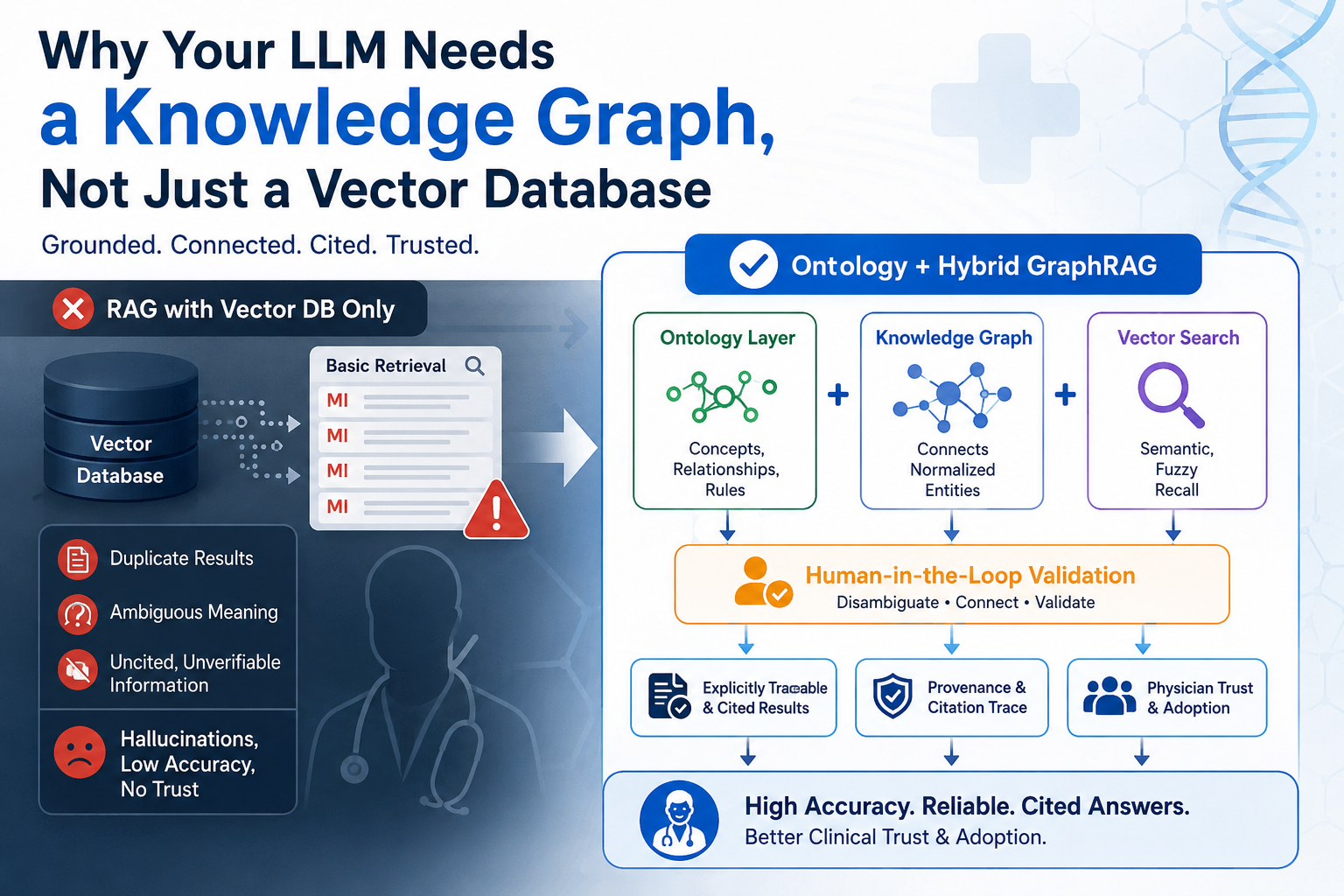
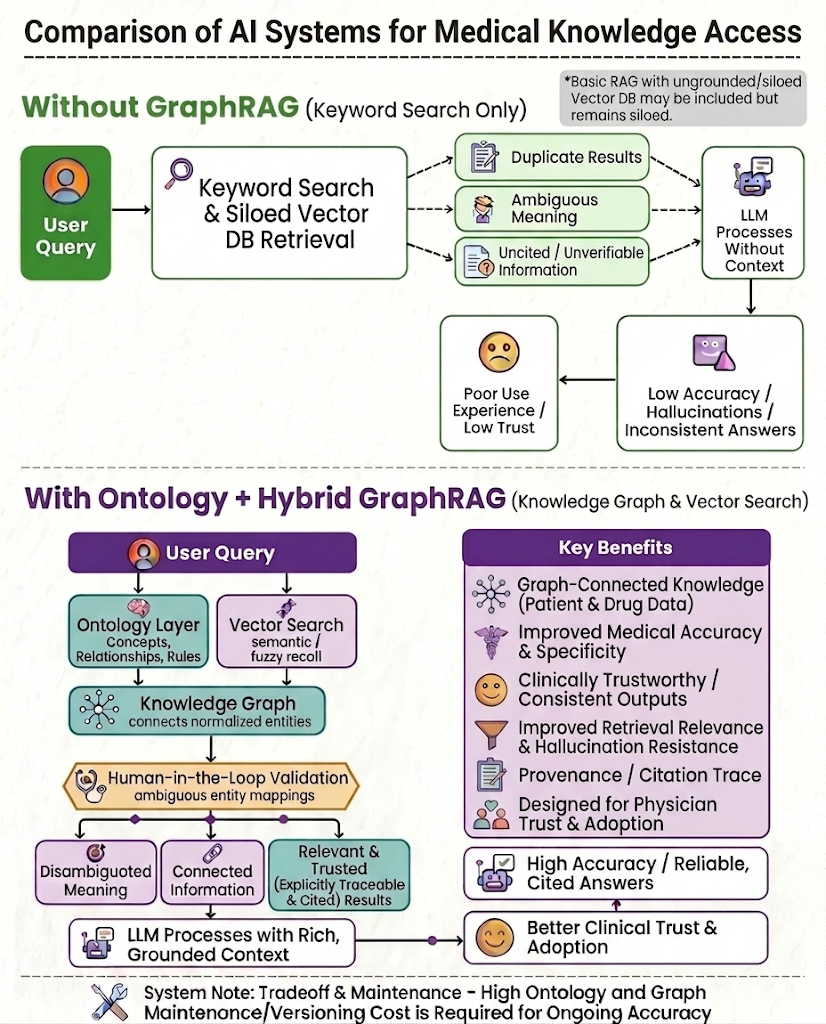
Most RAG setups today are keyword search bolted onto a siloed vector database. It sounds fine on paper: index the documents, embed them, pull the nearest neighbors, hand it to the model. In practice, in a medical or drug-data context, it falls apart fast.
A few things go wrong, over and over:
- Duplicate results. The same fact shows up in five documents with five slightly different wordings, and the retriever has no idea they're the same fact.
- Ambiguous meaning. "MI" means myocardial infarction in one chart and mitral insufficiency in another. Keyword matching and embedding similarity can't tell you which one you're looking at.
- Uncited, unverifiable information. Snippets get pulled out of their source with no trail back to where they came from.
Feed that to an LLM and you get exactly what you'd expect: hallucinations, inconsistent answers, low accuracy. For anything physician-facing, that's not a minor bug. It's the thing that kills trust, and once a clinician stops trusting a tool, getting them back is much harder than building the tool right the first time.
A Better Foundation: Ontology + Hybrid GraphRAG
The fix isn't to throw out vector search. It's to stop treating it as the whole system. We layer three things together instead.
An ontology layer
Defines the concepts, relationships, and rules of the domain, the shared vocabulary that lets "myocardial infarction," "heart attack," and "MI" all collapse into the same concept instead of three separate ones.
A knowledge graph
Built on that ontology, connects normalized entities: patients, drugs, conditions, interactions. Retrieval stops being "find similar text" and becomes "find connected, structured knowledge."
Vector search
Still earns its keep here. Semantic, fuzzy recall catches things the graph might miss. Neither one replaces the other; they work together.
The Step Most Systems Skip: Human-in-the-Loop Validation
Even a well-built graph runs into ambiguous entity mappings: a new drug name, an incomplete patient record, a term that means something different depending on the specialty. Instead of letting the model guess and move on, we route those cases through a human reviewer before treating them as ground truth.
Honestly, this is the step that separates a real system from a demo. It's slower and it costs more, but it's what produces:
- Disambiguated meaning, so nobody's guessing between two valid readings
- Connected information, tied to relevant clinical context
- Relevant, trusted results that are explicitly traceable and cited back to source
What This Actually Buys You
Feed the LLM this kind of grounded context instead of raw retrieval noise, and the benefits stack up:
- ✓Graph-connected knowledge across patient and drug data
- ✓Better medical accuracy and specificity
- ✓Clinically trustworthy, consistent outputs
- ✓Better retrieval relevance and more resistance to hallucination
- ✓A provenance and citation trail on every answer
- ✓A system actually built for physician trust and adoption
The end result is answers that are accurate, cited, and reliable, and over time, that's what builds clinical trust. Clinicians are (rightly) skeptical of black-box AI. Being able to show why an answer is right matters just as much as the answer itself.
The Honest Caveat
I don't think it's fair to sell this without the tradeoff, so here it is plainly: ontology and knowledge graph maintenance is ongoing engineering work, not a one-time build. Medical vocabularies change, new drugs and interactions show up constantly, and keeping the graph versioned and current takes real, sustained effort.
That's a genuine cost. But set it against the alternative, an LLM confidently making things up in a clinical setting, and it's a cost worth paying.
The tradeoff is clear: sustained engineering investment in exchange for clinical trust, reduced hallucinations, and answers physicians can actually rely on. In a regulated, high-stakes environment, that's not optional, it's foundational.
Smart Tech LLC: Building AI systems clinicians trust, grounded in knowledge graphs, validated by humans, and designed for the long term.